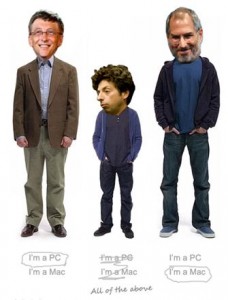
This is a 2010 cartoon. A lot's changed in a year, huh?
Why did Google buy Motorola Mobility? For the patents, or in preparation for a world where hardware, like software, is free and ad supported? This is a tricky thing to consider in the Mac Era where, “Apple needs people to congregate around a very small number of designs–phones that are placed on altars, so that people can genuflect beneath them before touching them with respectful gingerness.”
That’s a direct quote from a fascinating perspective of Mac vs. Google titled So Google now wants to be like Apple (Wait, what?). It’s written by Technically Incorrect writer Chris Matyszczyk, who spares no sucker punches on Google either: “Google is to emotional sustenance what Jessica Simpson is to opera. The company has always existed to impress–then please–engineers, with real people being a secondary market.”
But here’s where it gets interesting. Matyszczyk raises the question of whether Google wasn’t after Motorola patents as much as designing for a “free hardware” generation, which is no less plausible than a once-RIP Apple reviving digital purchases, fashionable, mainstream devices and demand so strong people were even willing to suffer AT&T to get an iPhone. Right?
“Apple needs people to pay good money for hardware. So why wouldn’t Google consider a world in which the hardware is free? Apple needs people to congregate around a very small number of designs–phones that are placed on altars, so that people can genuflect beneath them before touching them with respectful gingerness. So why wouldn’t Google march in the direction of allowing people to design their own phones, so that suddenly a Googorola phone is less the product of a brand and more an expression of the person who both created it and bought it? Aiming to be like Apple feels unimaginative, almost depressive. Inspiring real people to think that there is a world beyond Apple–one that might be even better, even more original– is something that ought to be Google’s challenge.
Hmmmm... free hardware? Sounds scary, but so did "free Microsoft" cloud-based alternatives a few years ago. Use Google documents lately?
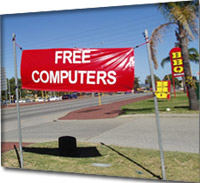
Consider the possibility of free hardware, or even free ad-supported cellular coverage. Like me, you may imagine cheap disposable pre-paid phones (itself no stranger 5 years ago than space cars). Or you might imagine an intrusive ad thrust before each phone call, like a pre-roll before a video.
Perhaps you pride yourself on being frugal, and willing to suffer through ads for free stuff, or even defeat them with hacks. Otherwise you might find yourself willing to pay a premium for that portable brain you carry and interact with for hours upon a day.
Matyszczyk’s characterization of Google is well founded. The culture is amiable but somewhat intellectually arrogant (or as he puts even better, “Google fancies itself as having brains bigger than Mars”). Sure we all use Google, but would we pay for it? Google has loads of users, but few that pay for the products and services. Is that by design or because it’s “good but not good enough?”
The Mac vs. Google battle has always fascinated me because I like them both for different reasons. I had almost forgotten about Microsoft until I grabbed that cartoon above (although it was funny hearing my son ask about Bing last night after seeing an ad the Glee Project). Google is like a smart friend, always better at helping me find stuff. Mac is like the fun friend, almost always more intuitive, friendly and integrated. It’s easy to imagine the Mac bubble bursting, and it’s also easy to imagine a “free everything by Google” era. But in the short run, I’d expect the next 5 years to be far less black and white. We’ll make important tradeoffs based on convenience, budget and user-experience.
Why? Consider these observations:
We’re feisty. Blackberry has shown that establishing corporate info-tech (IT) relationships as “barriers to entry” is a non-sustainable strategy, and that ultimately even dull business people’s devices are too important to. They’ve flocked to Droid and iPhones, and the faster hardware/telcom hybrid to appease nervous IT leaders will have a non-trivial advantage (ludicrous example: I can use my iPhone and expense $20 per month to my employer, but I bought a stupid Blackberry because then almost my entire voice/data plan can be expensed).
There’s probably a free alternative to most things you’ve bought digitally in the past year. I believe most WVFF readers are trend-setters in this space. But sometimes “free” is too much work. Remember that cable “cord cutters” remain in the significant minority.
Pick Mac. Pick Google. Just keep depending on technology, and don't mind me.
Our lives are becoming increasingly dependent on technology (thus of course preparing the machine to takeover humanity). That means that our expectations are higher, and we often value our time and experience more than an upcharge.
So sure the future will have free options, just like there is a lot of free television and video content available if you’re inclined to chase it down. But we’re irrational humans who dish out our money for emotional needs than wrap rational excuses around them. So as long as the humans still run the technology companies, there will still be un-free and we’ll run to them like lemmings.
I see three strategies for the whirlwind ahead: The “charge a premium and make the service and product a delight,” the “reasonably priced, and highly personalized,” and the “free and you get what you pay for.”
Australian’s Emallina, one of YouTube’s first “crossover” stars, has quit her blogging career after being hacked, according to TheAge.com (via Spamroll). Reports the Age, “someone had hacked into her computer and obtained recent pictures and videos from it that had never been posted online as well as “incredibly private files.” “Every day I logged in…
Views of any of my videos appears inversely related to a) how much time I put into them, and b) how much I like them. This parody of CES (consumer electronics show in Las Vegas) took longer than expected, but I don’t like it. So maybe the forces will counteract. Interested in the “making of”…
When do you book your plane flight to AdTech (April) in San Fran? a) When you commit to speaking b) When Daisy Whitney reminds you c) When AdTech puts you on its homepage d) A week before the event because you forgot e) Never because you don’t know the difference between LA and SanFran, so…
Obviously I don’t have “writers” for my videos. In fact I can barely find someone else to hold the camera, which is quite evident in my videos. But here are a few fun facts behind my “Writer’s Staff” series that is up to 8 episodes now. Months ago I met with the an NYC-based independent station about…
Here’s the note I got from SpecialOpsMedia when they were promoting “The Office” webisodes: The serialized, weekly arc will star the accounting staff of the Dunder Mifflin paper company in an edge-of-your-ergonomically-designed-seat whodunit. Also, we will be getting in prize packs with t-shirts as well as Dwight Shrute bobbleheads! And here’s the note I got…
3 Comments
If the department of justice allows this buyout, it will be on the condition that google does not do this. No, it’s not plausible at all. For $12.5 billion, they could start their own hardware company, but they didn’t, and they won’t, because it’s not in the plans.
The patents Motorola has aren’t enough to defend Android, but in the wrong hands they would definitely damage it further than apple, microsoft, and oracle are already doing. Microsoft was looking to buy Motorola. Google made their $12.5 billion offer to keep those patents on friendly turf. That is all.
$12.5 Billion? Google probably found that much under the sofa cushions!


If the department of justice allows this buyout, it will be on the condition that google does not do this. No, it’s not plausible at all. For $12.5 billion, they could start their own hardware company, but they didn’t, and they won’t, because it’s not in the plans.
The patents Motorola has aren’t enough to defend Android, but in the wrong hands they would definitely damage it further than apple, microsoft, and oracle are already doing. Microsoft was looking to buy Motorola. Google made their $12.5 billion offer to keep those patents on friendly turf. That is all.
$12.5 Billion? Google probably found that much under the sofa cushions!
I got nothing.