YouTube is debuting “call to action” overlays, which have some interesting applications for marketers and advertisers. This post dispels some confusion about this offering, and gives you tips to make stinkin’ amount of money on this functionality until everyone else catches up.
For some reason advertisers and marketers thought this functionality was already possible, but there were only two ways to create hyperlink overlays until now: a) a video owner could use an “annotation” to drive traffic to another YouTube page, or b) an advertiser could by Google Adsense cost-per-click or CPM ads (which appeared in the bottom 5th of video).
This new offering is really a “value-ad” to stimulate video owners to buy more of the undersold “promoted” videos, whereby the video owner pays YouTube a bid price (ranging from a penny to fifty cents) per click. Each time someone searches “prank,” I bid 1-5 cents per click. Like Google, it’s a low click-thru rate but I don’t pay unless they click. Chances are as a partner I’ll never make back the penny, but I’m experimenting to see how brands could benefit from this.
Again- here’s the criteria for this new offering, which is not being communicated well.
First, you can’t use it if you’re a video owner or partner who isn’t buying cost-per-click ads to promote your own videos.
Second, you can’t use this if you don’t own the video.
You need to both OWN the video and be running pay-per-click ads to promote it.
Example- if you search “Nalts” on YouTube and you see my Garbage Can prank video, then you should see the text overlay ad (although it’s not working now, presumably because it’s being run through editorial approval). I’m not clear as to whether this prevents me from monitizing the video via InVideo ads or adsense ads.
TechCrunch reports this feature helped a charity raise $10K in one day. This could improve video’s ability to drive traffic, a primary objective for many advertisers. For instance, I spoke with a client in the travel industry yesterday that was not impressed with “impressions” and awareness, but on direct response. Could his digital advertising be linked to selling rooms?
Unfortunately, most campaigns have a very small click-thru rate (in my experience 2-3 percent is healthy). I worked on a recent promotion for a major network’s web property, and saw a healthy 6% rate (the percent of viewers that visited the destination site). But imagine if it was easier to find the link (instead of buried in the description tab, where the viewer must select “more” before even seeing the hyperlink.
So What, Nalts… How Do I make Stinking Amount of Money Using This?
Want to make some quick cash while the rest of the industry gets hip to this? This should work well temporarily because YouTube is the 2nd most-popular search engine after Google, and most advertisers aren’t exploiting it yet. You’re at a distinct advantage if you buy keywords on YouTube and have a video thumbnail (instead of a text ad) as a resulting ad, and you’re probably not facing the bid competition you might on Google for the same terms. So go forth and make money using these tips, and thank Uncle Nalts later.
Create a destination website packed with some relevant information related to a sought-after area (like electronics, lawsuits, mortgages), and soak it with Google Adsense advertisements that yield high pay-per-clicks.
Create videos about the topic, and encourage people to visit your website for important information. Keep the video SUPER short or you’ve lost ‘em.
Post your videos, then bid on YouTube keywords via YouTube ads so people find your videos. Tag them well so you hopefully get some organic views too.
Be sure your bid price is not more than you’ll make back (cap it at 1-5 cents and 5 bucks per day initially). If you spend 50 cents to get them on your video, and only migrate 10 percent, then you’ll need to make $5 per visitor to break even. But if you bid a nickel and migrate 20 percent, you have a decent margin as long as people click some of your Adsense ads.
Now your “target” will hopefully convert well in three phases:
from a YouTube search to your video (at a low price)
from your video to your own publisher website (hopefully 10-20% of them)
from your website to the websites paying high cost-per-clicks to publishers (at a higher income to you than you paid YouTube).
Oh by the way- this isn’t sustainable. Eventually people will bid up the keyword prices on YouTube making the delta less significant. And in general it’s hard to justify paying for ads when your model is ad dependent.
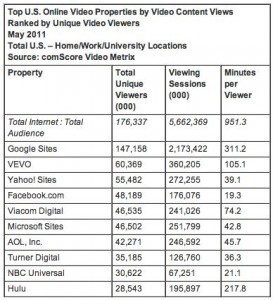
This morning I had the pleasure of meeting Hulu CEO Jason Kilar, who speaks elegantly about balancing his company’s three key customers: viewers, content producers and advertisers. His focus on convenience and simplicity of video content is unmatched, and is quickly turning Hulu into more than a website (Hulu recently jumped to #3 in online video, surprisingly beating Yahoo Video but not surprisingly beating “wheezing” AOL Video according to comScore).
Hulu CEO Jason Kilar
Kilar agreed to be in one of my goofball videos, but was not surprisingly swept away mid-morning as news broke of the Disney/Hulu deal. Catch ya next time, Kilar. We’re not offended that WVFF didn’t get an exclusive on the Disney deal before the networks.
A few notables from his talk private presentation (which I had the sad task of following). And, no, Nalts will not be appearing on Hulu. It’s focused on “professional” content, so I need not apply.
Awareness, message association, brand favor-ability and audience intent increase from 4-20% after Hulu ads.
He’s got a great new feature that allows consumers to select the ad, and an even cooler one that lets the advertiser survey the viewer (which gives the viewer fewer interuptions).
Still struggling with distribution beyond computers, because television can put him at odds with cable and networks. He doesn’t appear to be soon helping me watch Hulu on AppleTV.
A lot has changed since Hitchcock Presents (his mom’s favorite show- Kilar’s is Speed Racer, and he used to run home from school, only to catch it 9 minutes late). Hitchcock ran 4 minutes of ad times (with 26 minutes of show). But The Office runs 8 minutes of ads (with about 22 minutes of show). Hulu strives to keep ads to about 1/15th of program time, which seems more than fair. Consumers can choose to watch a 3-minute movie preview, then enjoy uninterrupted full episodes of shows.
Brand recall on Hulu is nearly twice what broadcast or cable provides (58% to 34% and 28% respectively). Same as message recall.
I expected to hear from an old-media junky, desperately pitching prerolls. Instead met an incredibly humble Pittsburgh dude who has a vision for how consumers can enjoy ad-supported content with higher convenience than television. He was at Amazon before Amazon was Amazon, and launched Hulu while launching his 3rd kid. He seemed mildly receptive to me renting his kids for videos.
Kilar likened Hulu to Starbucks, where consumption grows because of convenience. So watch for Hulu ubiquity via mobile, web and other mediums. Kilar reminded us of The Onion’s article: Starbucks Puts a New Starbucks Inside a Starbucks Restroom.”
Before we armchair quarterback Geico’s YouTube spend today, let me share a secret story. The names will be changed to protect the innocent.
An extremely popular YouTube star (let’s call him Spiffy) last fall mentioned something fascinating to me in private. A major consumer-products good brand (let’s call them “Yummy Snack”) paid him handsomly to create an enteratining video incorporating Yummy Snack. A member of the Yummy brand team had shared the success story at a conference I attended, but left something critical out. It seems Yummy’s agency hadn’t asked Spiffy to post the entertaining/promotional Yummy video on Spiffy’s channel!
The talented Spiffy voluntarily posted it on his channel, and THAT was the Yummy video that popped. Not one posted by Yummy Snack on some branded YouTube channel page. Not because media dollars drove views. I thought that Spiffy’s generous move was so cool, I’ve decided not to call out Yummy’s agency on this horrible oversight.
YouTube might have saved Yummy, but can you blame them? Google is more concerned about selling media dollars than tipping off agencies to the organic power of a star’s audience.
YouTube doesn’t make money when a promotional video goes viral… only when there’s an ad buy.
I like to think agencies have learned something in the past year, so it’s sad to find history repeating itself even today. Geico insurance purchased the expensive YouTube homepage spot to boast its ”Gecko & Numa Numa kid video,” which prerolls (without audio). Today’s ad spend cost the Geico more than you or I make in a year, and Gary Brolsma (NumaNuma), the online-video sensation, isn’t posting the video on his own channel concurrently.
Are you kidding me? Much of the value of the YouTube stars is his or her embedded audience. Most stars have fans that will propel the video to the top of the “most watched” and “highest rated,” and share it with friends (assuming it doesn’t suck).
As an example, if Fred made a video endorsing Poprocks, his video would get million of views. If the agency posted it — even with some advertising dollars promoting it — it would get far less.
For a moment, let’s put aside the debate about Geico’s agency associating itself with the NJ kid who is mostly a “one-hit wonder” lacking a recurring audience. Numa only has 35K subscribers and his recent videos are fetching just a few thousand views. Even so, Numa dual posting the video would certainly attract views for an ROI that’s as good as any media spend. The agency gets credit for driving homepage views to its own ”Its the Gecko,” channel instead of Numa Numa’s… but one can’t help but wonder if there’s a longer vision for that branded channel or if it was an afterthought.
Why on EARTH would Geico not pay Gary a few clams to post it on his channel? Even without a lot of daily views, Gary could have posted it on his channel concurrently, and gotten views by:
Showing us a “behind the scenes” footage
Featuring the video on his channel page
Making the Geico spot a video reply to his big hit, where it would get residual views
I’d love to know if this was an oversight or a thoughtful decision because, for instance, Gary wanted more coin to distribute it than made sense for the agency. But absent that, it’s going to be my case study for being “half pregnant” on YouTube– smart enough to tap a star and invest in media, but not savvy enough to tap into the creator’s audience as well.
The lesson: It’s not smart for brands to tap into know YouTube stars without buying media, and it’s not smart to buy media without getting some “street cred” from a known YouTuber. It’s smart to do both. Who’s going to help brands figure this out?
(I’d like to use the case study I referenced at the beginning, but the star would get tainted by the agency for mentioning this slip and ”Spiffy” doesn’t deserve it).
Coke and Google are soon to publish ROI data on a campaign in Germany that includes online video. The study isolates individuals who were not exposed to television but did see YouTube promotion, and reports incremental consumption data by various digitalchannels. Paid search leads, of course, and YouTube ranks high (far above banners, which showed almost no impact… and outdoor advertising).
Jens Monsees, who heads consumer goods and healthcare at Google in Spain, teased the audience with info, but results are to be published jointly by Coke and Google. Monsees was speaking at Exlpharma.com’s “Digital Pharma Europe” in Barcelona today.
It’s about time we had a marketing mix study that includes online video, and I look forward to seeing the details. BTW- the average YouTube viewer is 31 years old.
Note that this post and video were done before the game actually finished, so we may see some unexpected surprises and need to revise accordingly. What do you think? Have some favorites I didn’t mention, or some losers of your own?
Here’s a Hulu widget that lets you watch the Superbowl ads in HD…
Now here’s my top-10 list (you can also see Adweek for some coverage).
Number 10 was Coke’’s avatar ad– visually appealing and sentimental.
Number 9 may be the most quoted ad: “Think With Your Dipstick Jimmy” by Castrol. Annoying at first, but it grows on you like fine wine or oil sludge.
For spot 8… I don’t often like repeat campaigns but that eTrade baby did it again with talking babies.
Position 7 belongs to Dreamworks animated film “Monsters Verus Aliens” and the clips rocked even in 2D.
Number 6 belongs to CareerBuilder for reminding us that these symptoms may indicate it’s time to brush up the resume.
Number 5 goes to Denny’s who flip off iHop’s foo-foo pancakes. We need more Giggledrops, baby.
The fourth best ad belongs to Coke with its medley of animated insects. Ladybugs, like cows, sell.
The second greatest Superbowl ad this year goes to Pedigree Dogfood video, which features no dogs but will be the most talked about. Rhinos in cars? Common, peeps. If you didn’t laugh at that ad, check you funny pulse.Now for number 1: Miller Light’s “Deliver Guy” ad by Saatchi & Saatchi is the indesputable winner of pre and post game buzz. Windell Middlebrooks spent 17 hours taping these 1-second spots, and it worked.
Now the losers?
Spot 3 is the absurdly forced Gatorade ad featuring a collection of athletes and animated lizards. Puleez- 1996.
The second loser award goes to GoDaddy.com for still pitching hosting solutions with hot babes. That campaign is beaten to death, and is almost as bad as Peta’s banned veggie campaign. The absolute worst ad belongs to the biggest sellout since me. Ed McMahon’s Cash4Gold.comlong after we care.
Why watch the game, when you can catch all of the advertisements on these online-video sites? And hey- most of these ads don’t have any prerolls. That goodness Madison Avenue and the online-video sites are finally cooperating.
Wired magazine reports this month that it’s the GPS revolution in 2009. Remember a decade ago, when we heard stories about how you’d be passing Starbucks and suddenly receive a text/sms offer via your mobile phone? Yeah, that and the space cars I’m still waiting on.
Well here’s a glimpse into the dangers associated with GPS-based (location based) text advertising. Jo and I depicted the sad reality as we see it. We’d be passing stores just to get the discounts retailers would use to lure us back. Mind you this isn’t a sponsored video, so the Borders, Starbucks and California Tortilla appearances are just to make it more realish.
I’m not sure if other countries have introduced this technology, but I sure can’t wait for it in the US. That’s what I love about those free 411 services. You suddenly get text junk mail. Eww. And how creepy would it be to have an advertiser know exactly where you are at a specific time. Here’s hoping for opt-outs.
I’m posting the blip.tv version first because it’s a bit better resolution:
If I was smart, I’d focus on nailing another poorly promoted contest, instead of tossing my hat into this crowded ring.
Feel free to watch this video 9 times so that it makes it to the “most viewed” gallery.
Kudos to the agency for giving each entry a unique URL instead of the typical bloated flash website that has no way to direct link into a specific video.
The few videos I’ve viewed on the website’s gallergy pretty much suck, but as the deadline of early November approaches the semi-pros will storm the website with killer ads. Some of the entries last year looked like professional producers or agencies looking to get a big break. Here’s the best one so far (although the sex, TV, Doritos is a bit cliche, the payoff and execution is good).
Hey, good point there Nalts. There should be criteria. You qualify only if:
you spend less than 3 hours from concept to uploading,
you have the same person writing, shooting and editing, and
your camera cost no more than $1000.
I suppose I should enter separately the footage of my kids (these two kids are not mine, but I rented them to play to Doritos target demo) scrounging up the dropped Doritos like pigeons at a park.
If my co-worker Mike is reading this, he can kiss my ass with his comments about how I should have used fishing line and a Doritos on a pencil so it’s spinning even on the crane shot (in which I use a pool net to have the camera in the air). Kiss my ass, Mike. Where’s your stupid entry with the guy in college who lives on Doritos and has furniture made of Doritos. That’s almost as bad as some of these other hopefuls.
It’s unfortunate that most online-polls don’t provide an incentive. But if you do see a poll invitation surrounding an online video (on YouTube or other sites), I encourage you to participate, and do so thoughtfully and honestly.
I’ll briefly explain how they work, and why viewer feedback is so important to sustaining online-video model.
As you know, ads fund our online-video experience.
Content creators and YouTube don’t make a dime from viewers, so selling viewer eyeballs back to advertisers is the only way for them to cover costs and, daresay, profit.
But advertisers have to know if their ads work. Since few people click ads, we marketers are interested in if the ads changed people’s perceptions about our products or services (and if they’re more likely to buy).
It’s extremely difficult to get reliable data from a consumer about what drove their decision (they can’t accurately attribute the element of the marketing mix that was most influential). For example, most of my target consumers will claim television was the most influential, and we haven’t bought a television ad in a half-dozen years. Coupons are measurable, but usually “attitude and attribute” trackers are how we determine which half of advertising is working.
Typically online-video polls (through such vendors as Insight Interactive and Dynamic Logic) survey a test and a control sample. Simply put, those who have seen the ads and those who haven’t. They’re usually too long, and I have a hard time completing them myself.
How do we use the data? If the viewers who saw the ad like the brand (or better yet have increased “intention to buy”) more than the viewers that haven’t seen the ad, then the ad presumably was effective. A big difference between these ratings and we feel more confident that we’re driving sales. Since the investment in online-video ads is relatively paltry, then the ROI is likely to be positive.
Then, and only then, is the website and creator compensated beyond a pilot. As a result, the viewer can go about watching free content (and, of course, spending on the advertisers’ products or services). If ad-supported video content languishes, then creators will eventually fatigue (unless they’re OCD like me, and don’t seem to care that their hourly rate would be better at Taco Bell).
Bottom line: I encourage you to take polls. Don’t try to trick them, because they’re pretty savvy. But spend the time on them and consider the questions. Your incentive won’t be a free gift certificate, but you’ll know that you served your part to sustain the free-viewing model. Who wants the Cable TV model (fee for select programming) to hit online? Not me.
In the campaign’s infancy, the joke was based on people stumbling into Sasquatch — rather than being terribly surprised — deciding to play a harmless prank on him. In the end, he got the last laugh but it was subtle. In recent years, he chases people, smashes car windows, tosses people into trees, and knocks over golf carts. And the pranksters are less opportunistic and more mean spirited. There are hysterical moments like when he summons birds or chases bunnies. But I want to care about him not see him thrash mean prankster.
Brilliant campaign, but if it continues in 2009 I’d love to see a more human side of Sasquatch. We need to care about him, not root for his vengeance on dick pranksters. Maybe he needs a girlfriend.
Kevin "Nalts" Nalty is one of the most-viewed YouTube comedians with nearly 800 short online videos seen more than 74 million times. He also consults with top brands to help them engage in social media & video (check www.NaltsConsulting), and is chief strategical officer at Hitviews.com.
You know you'll forget where this site is. So subscribe now to the posts via e-mail by clicking here. If you'd like to have Nalts' latest YouTube delivered right to your inbox, clik here
Twitter Visitor?
Nalts is one of the most-viewed online-video creators. Want proof?